Popular votes
These are the ballots cast by voters. Each state counts its own votes. Adding the votes across the country gives the national popular vote.
Elections & voting
Your vote helps decide your state’s electoral votes. Those votes decide who wins the presidency.
Rules reviewed October 17, 2026 · Results example: 2024
Start here
These are the ballots cast by voters. Each state counts its own votes. Adding the votes across the country gives the national popular vote.
These are cast by people called electors. Your vote for president helps choose the electors who will represent your state. They are usually pledged to a candidate.
The Electoral College is a process, not a school. Electors meet in their own states to vote for president and vice president.
That adds up to 538 electoral votes. More than half is 270. This is the winning number when all 538 count toward the required majority.
Each state gets one elector for each of its House seats, plus two for its senators. Electors are separate people; members of Congress cannot serve as electors. D.C. gets three electoral votes under the 23rd Amendment.
The candidate with the most votes statewide gets all of that state’s electoral votes. This is called winner-take-all. A candidate can win with less than half the votes if no other candidate gets more.
The statewide winner gets two electoral votes. The winner in each congressional district gets one more. This lets a state split its electoral votes between candidates.
Example: A narrow win and a large win can earn the same number of electoral votes in a winner-take-all state. That is why the national popular-vote leader can lose the presidency.
From ballots to a new term
This timeline uses the completed 2024 election. Election Day and the December dates vary by year.
Voters choose a president and vice president together. State rules turn the results into a choice of electors.
States follow their rules for counting ballots, checking results, and making results official. A news report calling a winner does not replace this work.
State executives must issue a certificate naming the chosen electors. Court rulings can require changes to a certificate.
They meet in their states and cast separate votes for president and vice president.
The House and Senate meet together. The votes are opened, counted, and announced.
The Constitution sets this time. The president must also take the oath before carrying out the duties of the office.
A real example
Republican · electoral votes
Democratic · electoral votes
Congress counted these votes on January 6, 2025. The winning total was above the 270 needed.
These are electoral votes, not individual voters’ ballots. A zero means the candidate received no electoral votes there.
| State or district | Trump (R) | Harris (D) | Total |
|---|---|---|---|
| Alabama | 9 | 0 | 9 |
| Alaska | 3 | 0 | 3 |
| Arizona | 11 | 0 | 11 |
| Arkansas | 6 | 0 | 6 |
| California | 0 | 54 | 54 |
| Colorado | 0 | 10 | 10 |
| Connecticut | 0 | 7 | 7 |
| Delaware | 0 | 3 | 3 |
| District of Columbia | 0 | 3 | 3 |
| Florida | 30 | 0 | 30 |
| Georgia | 16 | 0 | 16 |
| Hawaii | 0 | 4 | 4 |
| Idaho | 4 | 0 | 4 |
| Illinois | 0 | 19 | 19 |
| Indiana | 11 | 0 | 11 |
| Iowa | 6 | 0 | 6 |
| Kansas | 6 | 0 | 6 |
| Kentucky | 8 | 0 | 8 |
| Louisiana | 8 | 0 | 8 |
| Maine | 1 | 3 | 4 |
| Maryland | 0 | 10 | 10 |
| Massachusetts | 0 | 11 | 11 |
| Michigan | 15 | 0 | 15 |
| Minnesota | 0 | 10 | 10 |
| Mississippi | 6 | 0 | 6 |
| Missouri | 10 | 0 | 10 |
| Montana | 4 | 0 | 4 |
| Nebraska | 4 | 1 | 5 |
| Nevada | 6 | 0 | 6 |
| New Hampshire | 0 | 4 | 4 |
| New Jersey | 0 | 14 | 14 |
| New Mexico | 0 | 5 | 5 |
| New York | 0 | 28 | 28 |
| North Carolina | 16 | 0 | 16 |
| North Dakota | 3 | 0 | 3 |
| Ohio | 17 | 0 | 17 |
| Oklahoma | 7 | 0 | 7 |
| Oregon | 0 | 8 | 8 |
| Pennsylvania | 19 | 0 | 19 |
| Rhode Island | 0 | 4 | 4 |
| South Carolina | 9 | 0 | 9 |
| South Dakota | 3 | 0 | 3 |
| Tennessee | 11 | 0 | 11 |
| Texas | 40 | 0 | 40 |
| Utah | 6 | 0 | 6 |
| Vermont | 0 | 3 | 3 |
| Virginia | 0 | 13 | 13 |
| Washington | 0 | 12 | 12 |
| West Virginia | 4 | 0 | 4 |
| Wisconsin | 10 | 0 | 10 |
| Wyoming | 3 | 0 | 3 |
| Total | 312 | 226 | 538 |
Source: National Archives official results and state certificates
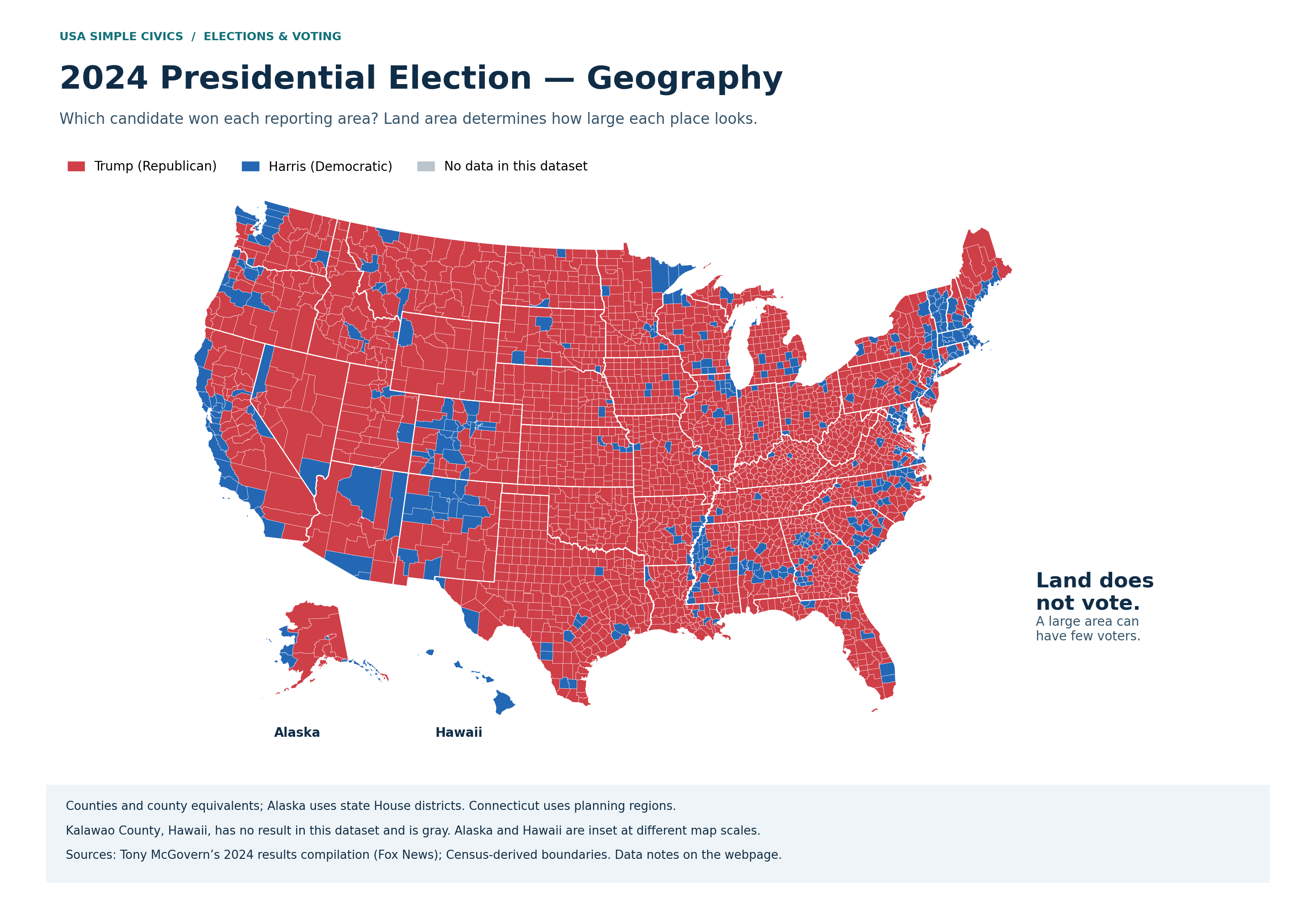
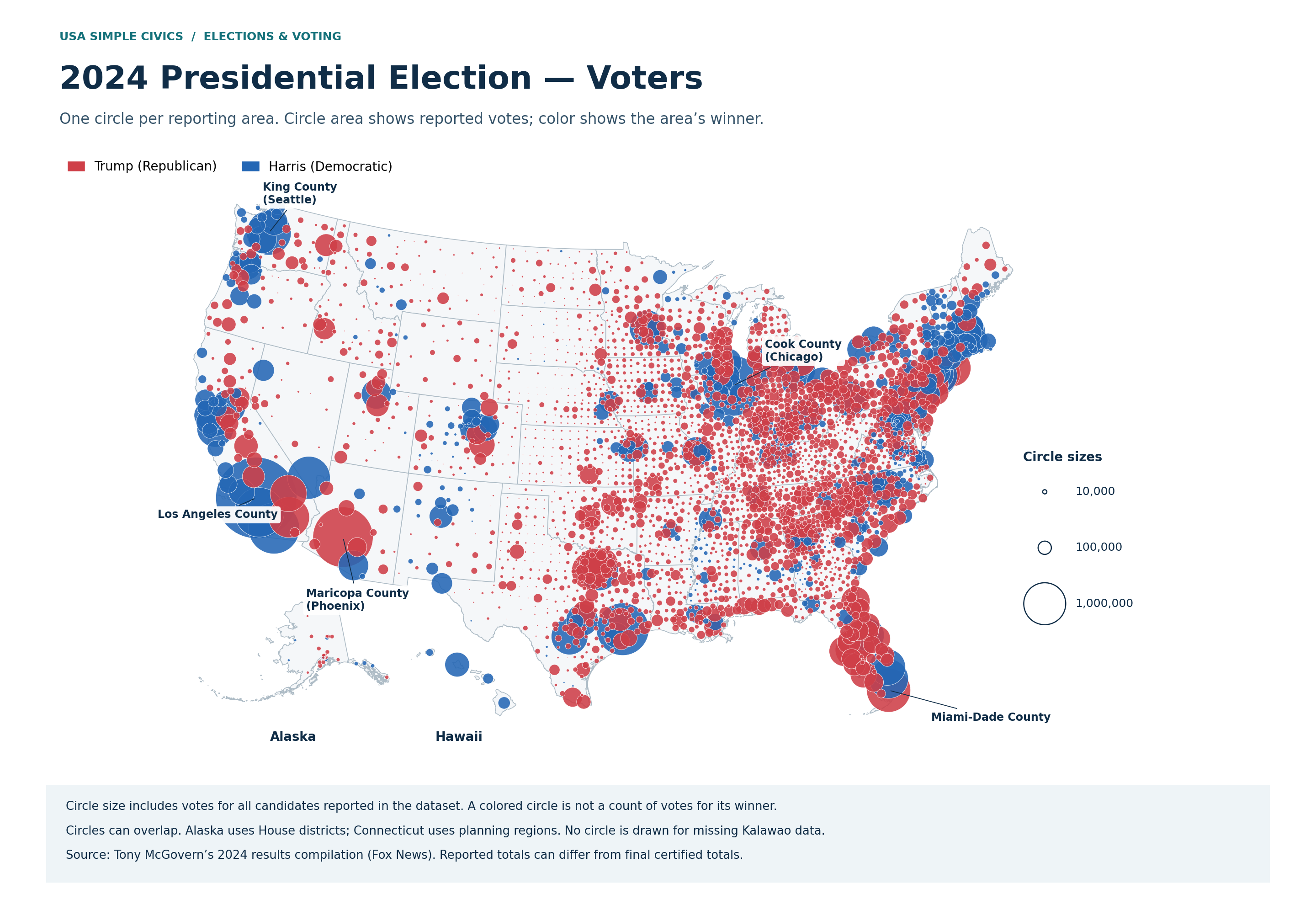
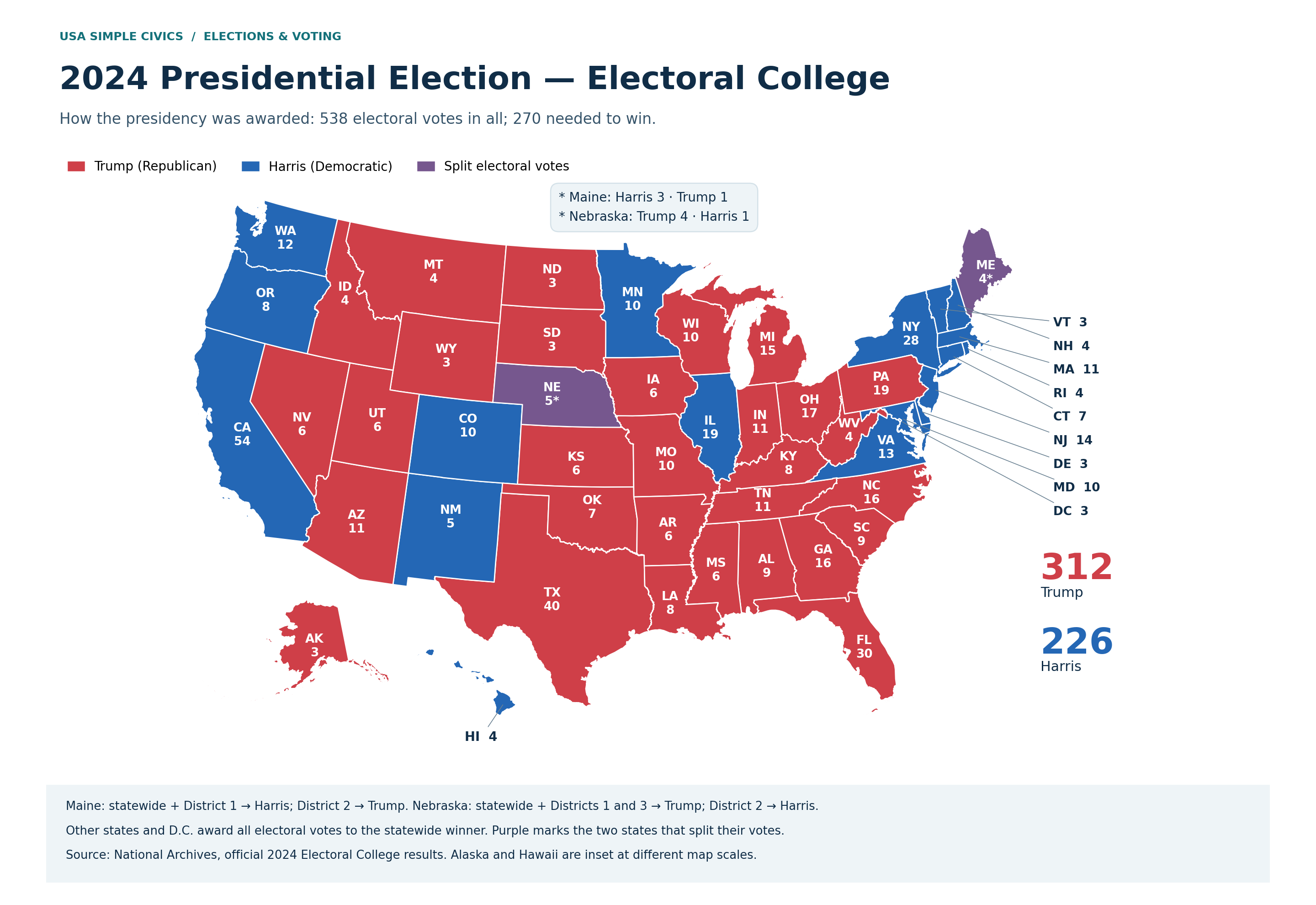
These maps answer different questions. A place’s land area, number of voters, and electoral votes are three different measures.
Large places take up more space, even when few people live there. Color shows which candidate won each reporting area.
 Click or tap to enlarge ↗
Bigger circles mean more reported votes. Each circle includes votes for all candidates; its color shows who won that area. Circle sizes use the same scale across the map, including Alaska and Hawaii.
 Click or tap to enlarge ↗
The official count was Trump 312 and Harris 226. Nevada’s six electoral votes went to Trump. Purple marks Maine and Nebraska, which split their electoral votes.
 Click or tap to enlarge ↗
County and voter maps: Built from Tony McGovern’s 2024 results compilation, which collects Fox News reporting. These are reported figures, not a new audit of every county’s certified results. Later corrections or differences in write-in reporting can change totals.
Missing does not mean zero: Kalawao County, Hawaii, has no result in this dataset. It is gray on the land map and has no circle on the voter map. All other 3,153 mapped reporting areas have results. D.C.’s eight ward results were added together.
Circle sizes: Circle area, rather than width, is proportional to total reported presidential votes. Circles sit within their reporting areas and can overlap. City names identify familiar locations within counties; they are not separate city totals.
Electoral College: Every state and D.C. is matched to the National Archives’ official results. Maine and Nebraska are labeled as split states; their individual districts are explained below the map.
Boundaries: 2023 Census cartographic boundary files, obtained through the compilation’s repository. Small boundaries are simplified for display. Maps rebuilt October 17, 2026.
Download the mapped county data · Download electoral votes · Full source notes
Questions and special cases
The House chooses from the top three presidential electoral-vote candidates. Representatives vote within state groups, called delegations. Each state gets one vote in the final count. A candidate needs 26 states.
If no vice-presidential candidate wins an electoral majority, the Senate chooses from the top two. Each senator gets one vote. With 100 senators, 51 votes are needed.
These are separate rules for the two offices. D.C. has no vote in either choice. If the House has not chosen a president by the start of the term, a qualified vice president-elect acts as president. Other succession rules apply if neither office has a qualified winner.
No. The vice president leads the count but cannot decide on their own to accept or reject electoral votes. The Electoral Count Reform Act of 2022 made this limit explicit.
An objection needs written support from at least one-fifth of each chamber. It must concern whether electors were lawfully certified or their votes were properly cast. Both chambers must agree to reject votes.
An elector who breaks a voting pledge is often called a “faithless elector.” State laws differ. In Chiafalo v. Washington (2020), the Supreme Court ruled that states may enforce these pledges. Faithless votes have not changed who won a presidential election.
No. A concession speech does not decide the legal result or stop the official election process.
Sources: Constitution and federal law · National Archives FAQ · Supreme Court ruling
How it developed
The Constitution’s writers debated having Congress choose the president or having voters choose directly. They settled on electors. This gave states a role and kept the choice separate from Congress in most elections.
Slavery also shaped political power. Enslaved people could not vote, but the Three-Fifths Clause counted part of their population when dividing House seats. That gave slaveholding states more House seats and electoral votes than they would have had if only free people were counted.
At first, electors cast two votes without marking one for president and one for vice president. In 1800, Thomas Jefferson and his running mate Aaron Burr tied at 73 votes each. The House chose Jefferson. The 12th Amendment, ratified in 1804, required separate votes for the two offices.
The 23rd Amendment gave Washington, D.C., a role in presidential elections. D.C. first voted for president in 1964.
Congress revised the electoral-count law. It clarified the vice president’s role and raised the number of lawmakers needed to bring an objection.
This happened in 1876, 1888, 2000, and 2016.
1824 needs a note: Andrew Jackson led the recorded popular vote and the electoral vote, but had no electoral majority. The House chose John Quincy Adams. Some states let their legislatures choose electors, so there was no complete nationwide popular vote to compare.
Sources: Electoral College history · 1800 results · Slavery and the Constitution · Constitutional amendments
These are arguments about how elections should work.
Supporters value the states’ role in choosing the president. Some also argue that candidates should build support across different states.
Critics want the candidate with the most votes nationwide to win. They also object to differences in voting power between states and the focus on a few closely divided states.
Reviewed October 17, 2026. The 2024 results are final electoral votes, not forecasts. State vote allocations shown also apply to 2028. Check official guidance for future election dates and rule changes.