Founding Documents
📜 Bill of Rights
The Bill of Rights is the first 10 amendments to the Constitution.
These amendments protect major freedoms like speech, religion, fair trials, privacy, and protection from certain government abuses.
See the Original Document
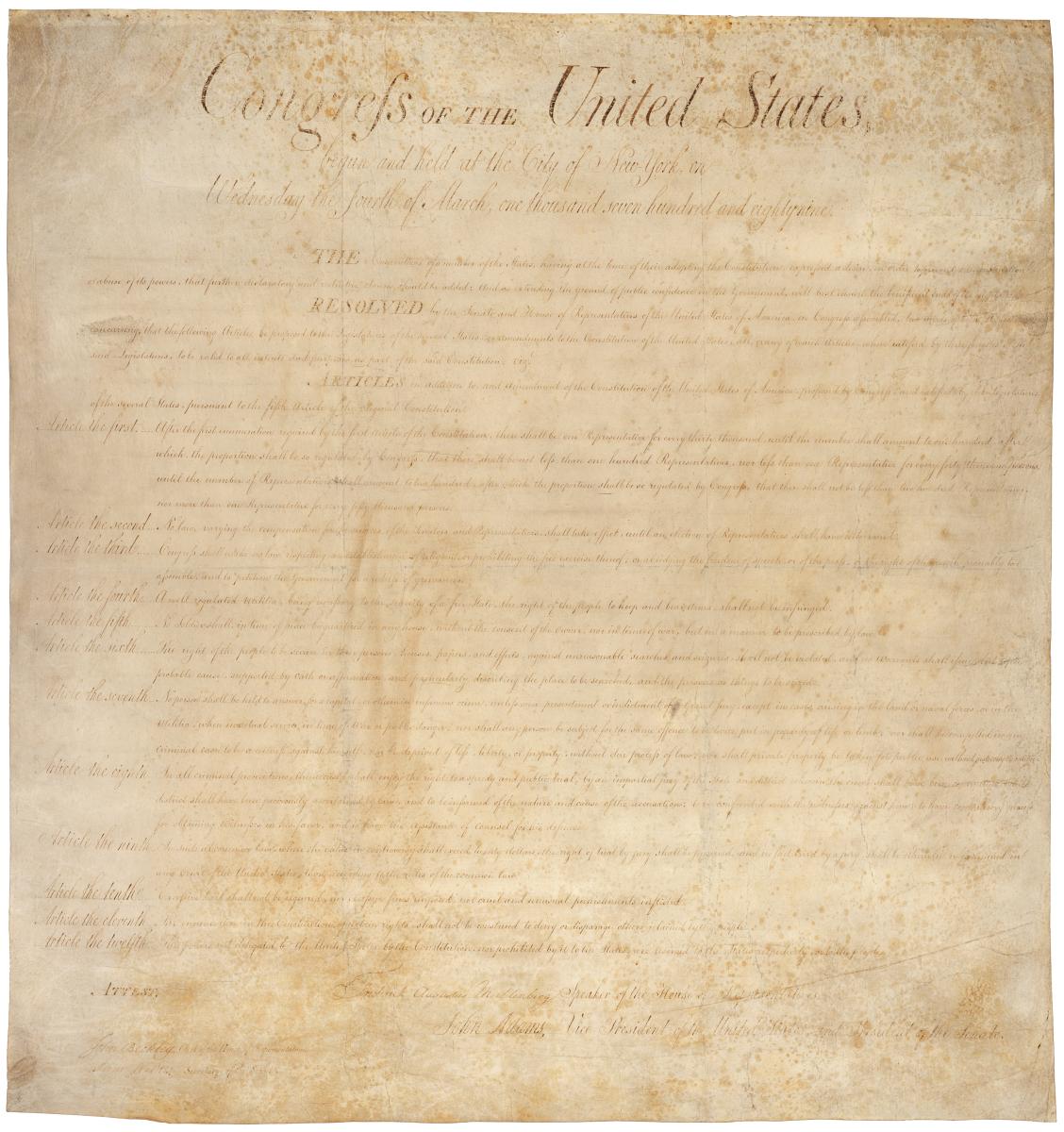
View full-size document (opens in a new tab)
💡 Main Ideas
- The government cannot take away certain basic rights.
- People have freedoms like speech, religion, and assembly.
- People have protections if they are accused of a crime.
- Courts can use these amendments to test whether laws are constitutional.
🔟 The First 10 Amendments in Plain English
1st Amendment
Protects freedom of speech, religion, press, assembly, and the right to petition the government.
Example: You can sign a petition asking your city council to change a policy or join a peaceful protest.
2nd Amendment
Protects the right to keep and bear arms.
Example: A law-abiding adult keeping a handgun at home for self-defense is an example of the right recognized by the Supreme Court. The right has legal limits.
3rd Amendment
The government cannot force people to house soldiers in their homes during peacetime.
Example: During peacetime, you can refuse a government demand to let soldiers live in your home.
4th Amendment
Protects people from unreasonable searches and seizures.
Example: A search warrant for your home must rest on probable cause and specify what may be searched or seized.
5th Amendment
Protects due process, prevents double jeopardy, and says people cannot be forced to testify against themselves.
Example: A person on trial can choose not to testify rather than be forced to give evidence against themselves.
6th Amendment
Protects the right to a speedy and public trial, an impartial jury, and legal counsel in criminal cases.
Example: A person accused of a crime has the right to know the charges and have a lawyer assist with their defense.
7th Amendment
Protects the right to a jury trial in certain civil cases.
Example: In a qualifying federal civil lawsuit over money damages, a party can request a jury to decide disputed facts.
8th Amendment
Protects against excessive bail, excessive fines, and cruel and unusual punishment.
Example: A person can challenge a government fine as constitutionally excessive.
9th Amendment
Says people may have rights not specifically listed in the Constitution.
Example: An official cannot dismiss a claimed right solely because it is not named in the Constitution. That does not automatically establish every claimed right.
10th Amendment
Says powers not given to the federal government are generally left to the states or the people.
Example: States set many local rules, such as driver-licensing requirements, while still having to respect the Constitution and valid federal law.
These simplified examples illustrate the protections; how a right applies depends on the situation. Sources: National Archives — full text, amendment summaries, and District of Columbia v. Heller.
🖋️ Original Words, Plain English
Original idea
“Congress shall make no law... abridging the freedom of speech...”
Plain English
The federal government cannot simply ban people from speaking because it dislikes what they say.
Original idea
“The right of the people to be secure... against unreasonable searches and seizures...”
Plain English
The government usually needs a valid legal reason before searching people, homes, papers, or property.
Original idea
“nor shall any person... be compelled in any criminal case to be a witness against himself...”
Plain English
People accused of crimes cannot be forced to testify against themselves.
Original idea
“nor cruel and unusual punishments inflicted.”
Plain English
Punishments cannot be extreme, abusive, or outside constitutional limits.
⚖️ How Laws Relate to the Bill of Rights
Laws cannot take away rights protected by the Bill of Rights.
Courts often use these amendments when deciding whether a law, government policy, search, punishment, or trial process is constitutional.
⚠️ Important Context
The Bill of Rights originally limited the federal government. Over time, many protections were applied to state and local governments through the 14th Amendment and court decisions.
Some rights are still debated today because courts must decide how old constitutional language applies to modern situations.
🏛️ Why It Still Matters
The Bill of Rights affects modern debates about free speech, religion, criminal justice, privacy, protests, weapons, policing, punishment, and the power of government.
Many major Supreme Court cases are about how these rights should be interpreted.
📚 Sources
- National Archives — Bill of Rights
- Library of Congress constitutional materials
- U.S. Courts educational resources
- Constitution Annotated materials from Congress.gov
🔗 Live Source Links
-
National Archives — Bill of Rights:
archives.gov/founding-docs/bill-of-rights -
Constitution Annotated — Library of Congress / Congress.gov:
constitution.congress.gov -
U.S. Courts — Educational Resources:
uscourts.gov